AEO vs SEO is a critical comparison in today’s evolving digital landscape, where simply ranking high on search engines is no longer enough. With the rise of zero-click searches and AI-powered voice assistants, businesses must adapt their strategies to remain visible and relevant. This is where Search Engine Optimization (SEO) and Answer Engine Optimization (AEO) come into play. While both aim to enhance online visibility, they differ significantly in approach and purpose. In this blog, we’ll explore the key differences between SEO and AEO-and why combining both can future-proof your content strategy.
AEO vs SEO: Important Distinction
SEO and AEO target different aspects of search results, but both focus on improving a website’s visibility and relevance. Each plays a key role in helping content reach users effectively. Combining AEO and SEO boosts visibility and improves user engagement. Together, they strengthen your digital marketing impact. This includes increasing traffic and offering straightforward responses.
| Aspects |
AEO (Answer Engine Optimization) |
SEO (Search Engine Optimization) |
| Main Goal |
Provide straightforward responses to user inquiries |
Increases website traffic by appearing higher in search results |
| Emphasis on Content |
Brief, to-the-point, and answer-focused content |
In-depth, thorough stuff for further in-depth knowledge |
| Search Interaction |
One-click searches which show results immediately |
Click-through searches (when a user goes to a website to find out additional information) |
| The purpose of the query |
Responds to direct, targeted inquiries (e.g., “What is AEO?”) |
Broad purpose, such as transactional, informational, etc. |
| Targeted Devices |
For voice and Al-powered devices primarily |
Mostly for web browsers on desktops and mobile devices |
| Technical Components |
Schema markup and structured data for improved response accuracy |
Title tags and meta descriptions are examples of common on-page SEO components |
| Experience of the User |
Fast, real-time information dissemination |
Promotes more in-depth exploration, interaction, and browsing |
| Examples |
Include Google Featured Snippets and voice assistants like Siri and Alexa |
Conventional Google, Bing, and other search engine results etc. |
| KPIs |
Featured snippet visibility and response accuracy |
Click-through rate, keyword ranks, and organic traffic |
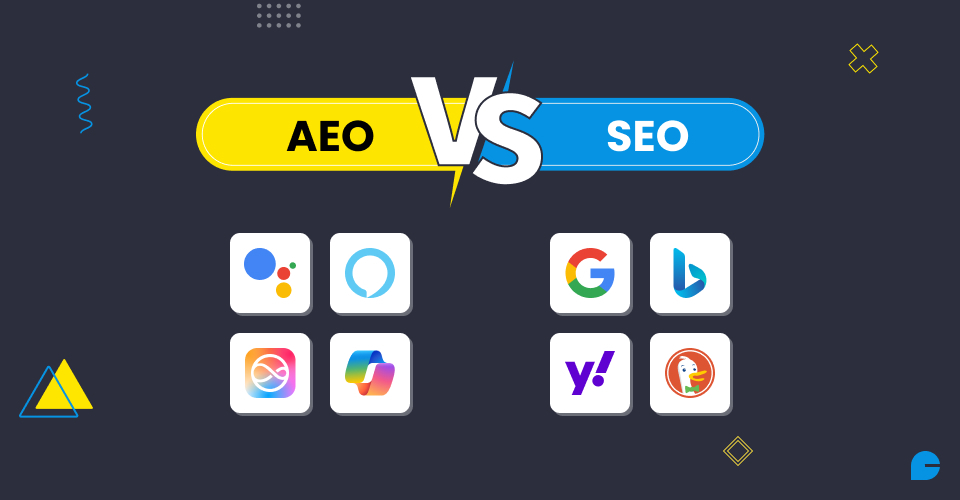
Comparison of Goals: Web Traffic vs. Direct Responses
Their goals are the main area where AEO and SEO differ from one another:
- SEO’s Goal: Drive Website Traffic: The goal of traditional SEO is to optimize a website so that it will draw visitors from natural search results. Through better positioning on search engine results pages (SERPs), SEO seeks to boost a website’s traffic.
- AEO’s Goal: Provide Direct Answers: However, search engine optimization (AEO) concentrates on making material, like voice search results, knowledge panels, and featured snippets, more likely to be chosen by search engines as the solution in zero-click searches. Without requiring the user to navigate through to the website, AEO seeks to answer their query.
Optimization Strategies and Content Structure
Although both SEO and AEO rely heavily on content optimization, their methods and frameworks vary according to their goals.
- SEO Content Structure: Long-form, in-depth content with an emphasis on comprehensiveness and keyword targeting is usually necessary for SEO. Conventional SEO techniques strive for material that is relevant, keyword-rich, and optimized for long-tail search phrases while providing answers to a wide variety of searches.
- AEO Content Structure: Search engines may easily extract the content as featured snippets or present it in other rapid answer formats because it is organized to offer immediate value in a question-and-answer manner. Frequently included in content geared for AEO are:
- Clear, concise paragraphs
- Bullet points or lists
- Prompt, straightforward answers to particular queries
- Simple language that is frequently written for a lower reading level
Consider User Intent and Types of Queries
Although user intent is fundamental to both SEO and AEO, the two approaches take different approaches to it.
- SEO Focuses on Broad User Intent: A broad spectrum of search intents, including transactional, navigational, and informative ones, are targeted by traditional SEO. Long-tail, semantic, and synonym keywords are just a few of the varieties of keywords used in SEO-optimized content to cover a wide range of possible queries.
- AEO Focuses on Specific Queries and Instant Answers: However, AEO is more concerned with providing immediate, targeted answers. It’s all about answering a specific user question. Instead of surfing or delving into a wide range of topics, these kinds of searches are usually more concise and geared on information retrieval.
Technical Disparities: Page Speed, Schema Markup, and Mobile Optimization
Though the focus on each component varies, technical considerations are necessary for both SEO and AEO.
- Between SEO and AEO, Schema Markup: In SEO, schema is usually used to help search engines classify information and enhance the look of search results (like rich snippets). Schema markup is more essential in AEO for allowing rapid responses and showing up in knowledge panels or featured snippets.
- Page Speed: Although it has always been a crucial ranking criteria in SEO, page speed is particularly significant in AEO. The rationale is that in order to provide the best possible user experience, voice search results and highlighted snippets give priority to fast loading speeds. Faster page speeds with AEO guarantee that information is instantly accessible for AI-powered platforms and voice assistants, increasing exposure in voice search results.
- Optimization for mobile devices: Local and mobile queries are becoming more and more common among consumers as voice search and AI-powered assistants gain popularity. Both SEO and AEO depend on mobile-friendly websites, but voice search results are where they really shine. AEO mostly depends on making material accessible, legible, and useable on smartphones and other mobile devices via optimizing for mobile-first indexing.

AEO and SEO Combination Benefits
Combining AEO and SEO helps brands boost digital visibility and performance. It also enhances user engagement across search platforms.
Making Your Brand More Visible on Several Search Platforms
AEO and SEO together offer the main advantage of increasing brand presence on a variety of search platforms. Traditional SEO focuses on ranking high in Google’s search results. AEO boosts visibility in voice search, Google Assistant, and featured snippets.
Keeping Long-Form Content and Instant Answers in Balance
When AEO and SEO are combined, organizations may achieve the ideal balance between supplying long-form, in-depth information and quick fixes.
Businesses can utilize AEO to optimize content so that it is concise and pertinent to users’ individual inquiries. This strategy meets the growing need for immediate responses in a digital environment that moves quickly. But SEO makes sure that the pages on your website include long-form, thoroughly researched content that may still rank for more competitive, general search phrases.
Effect on Engagement and User Experience
Optimizing content to increase user accessibility and relevance is the main goal of both SEO and AEO. AEO optimizes content to respond to queries rapidly, giving users immediate satisfaction and minimizing the need for them to navigate through several pages. In the meantime, SEO makes sure that your website provides excellent, organized content that meets visitors’ needs for thoroughness and depth.
SEO content boosts time-on-site, reduces bounce rates, and enhances engagement. AEO content appears in interactive formats like voice search, encouraging quick user responses.
Conclusion
AEO is the development of search, giving users immediate answers to their questions. This modification emphasizes how crucial it is to provide content that works with AI-driven technologies in addition to ranking highly on conventional search engines. Businesses must modify their tactics to be visible to users across various search platforms as zero-click searches and voice-activated responses become more common.
Businesses must mix SEO and AEO to remain competitive in this quickly changing market. AEO will make sure your brand appears in the increasingly common zero-click search results, while SEO will continue to generate long-term online traffic. Using combined SEO and AEO tactics can help firms keep ahead of the curve and stay relevant in the search engine optimization landscape as it continues to change.
At InCreativeWeb, we focus primarily on SEO strategies that drive long-term traffic, improve rankings, and strengthen your digital presence across search engines. From keyword optimization to technical SEO and content planning, we help brands grow organically. To complement this, we integrate Answer Engine Optimization (AEO) techniques like featured snippet targeting and voice search readiness—ensuring visibility in zero-click and AI-powered search environments. Talk to our SEO specialists to boost your rankings and get AEO-ready for the future of search.
Author
Jayesh Patel
Jayesh Patel is a Professional Web Developer & Designer and the Founder of InCreativeWeb.
As a highly Creative Web/Graphic/UI Designer - Front End / PHP / WordPress / Shopify Developer, with 14+ years of experience, he also provide complete solution from SEO to Digital Marketing. The passion he has for his work, his dedication, and ability to make quick, decisive decisions set him apart from the rest.
His first priority is to create a website with Complete SEO + Speed Up + WordPress Security Code of standards.