Generative Engine Optimization (GEO) is the practice of structuring web content so AI systems like ChatGPT, Perplexity, and Google AI Overviews can accurately understand, extract, and cite a brand in their generated answers. It matters because search behavior has shifted: a growing share of queries are now answered directly inside AI-generated summaries rather than through a list of clicked links, according to Google’s own reporting on AI Overviews.
If an AI engine hallucinates details about your services, recommends a competitor, or leaves your business out entirely, you lose customers before they ever reach your site.
To stay competitive, businesses need to pivot toward Generative Engine Optimization. Below is an expert guide to the best AI visibility tools for GEO in 2026, along with the evaluation criteria and optimization strategies InCreativeWeb uses to build AI search presence for clients.
What Makes a Top-Tier AI Visibility Tool?
When evaluating Generative Engine Optimization (GEO) platforms, look for these critical features:
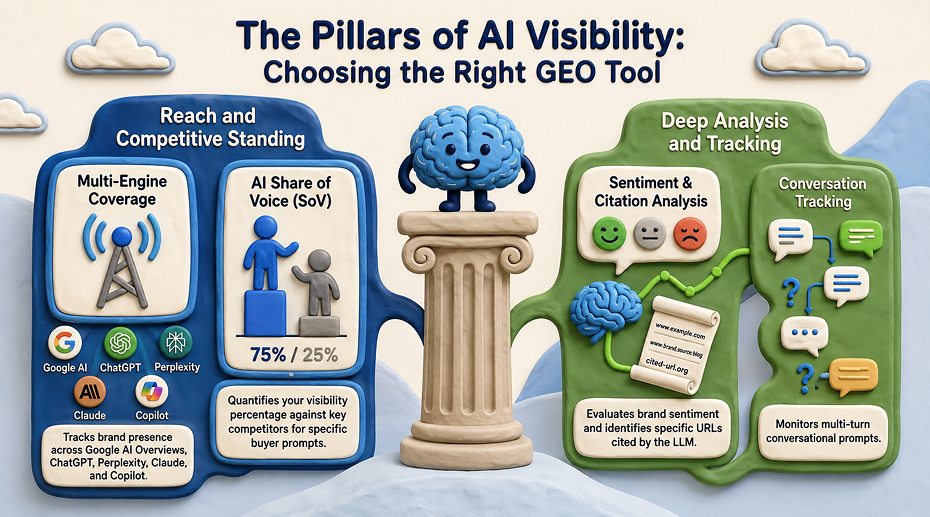
- Multi-Engine Coverage: Tracks prompts across Google AI Overviews, ChatGPT, Perplexity, Claude, and Copilot.
- Sentiment & Citation Analysis: Identifies whether your brand is mentioned positively, neutrally, or negatively, and highlights which exact URLs the LLM cited.
- AI Share of Voice (SoV): Quantifies your visibility percentage against key competitors for specific buyer prompts.
- Prompt & Conversation Tracking: Tracks multi-turn conversational prompts rather than just static keywords.
Detailed Breakdown of the 8 Best AI Visibility Tools
1. Profound: Best for Enterprise Brand Tracking & Prompt Analytics

Profound is an AI brand monitoring platform that tracks how enterprise brands appear across large language models. It works best for mid-to-large enterprises that need ongoing AI brand protection and competitive intelligence instead of a one-time audit.
- What it does: Monitors real, multi-turn user prompts across major AI models instead of relying on simplified API queries.
- Key features: Real-time sentiment tracking, prompt trend discovery, regional share-of-voice analytics, and citation source detection.
- Best for: Mid-to-large enterprises managing brand risk across multiple AI platforms.
- Pricing: Starts from approximately $99/month, billed annually (verified August 2026).
2. Otterly.AI: Best for Affordability & Small Business GEO
Otterly.AI is a budget-friendly AI monitoring tool built for small businesses and boutique marketing agencies transitioning into AI optimization. It is best suited for teams that want a simple, low-cost way to see how they’re being represented in AI answers without a steep learning curve.
- What it does: Runs automated prompt checks against major AI engines and summarizes brand mentions on a recurring basis.
- Key features: Automated prompt checks, simple sentiment reporting, competitor tracking, and weekly brand mention summaries.
- Best for: Startups, local businesses, and small agencies looking for an easy, low-cost entry point into GEO.
- Pricing: Free tier/trial available; paid plans start around $29/month (verified August 2026).
3. Peec AI: Best for AI Recommendations & Strategy Suggestions
Peec AI is a GEO analytics platform that explains why a site was omitted or downranked in an AI-generated answer and turns that gap into a concrete action plan. It is best suited for content teams that need clear next steps, not just visibility scores.
- What it does: Analyzes AI answer omissions and generates content optimization recommendations tied to specific prompts.
- Key features: Automated content gap suggestions for GEO, prompt performance scoring, competitor comparison matrices, and source link tracking.
- Best for: Content marketers and SEO strategists who need actionable guidance on what to fix, not just what’s wrong.
- Pricing: Starts at $80/month (verified August 2026).
4. ZipTie.dev: Best for Deep Technical AI Overview Analysis
ZipTie is a technical SEO platform built specifically for publishers targeting Google AI Overviews. It is best suited for technical SEOs who need crawler-level detail rather than surface-level brand sentiment.
- What it does: Breaks down exact indexation status, crawler behavior (including GPTBot and PerplexityBot), and technical factors affecting AI citations.
- Key features: AI Overview snippet scraping, technical crawler audit logs, citation URL breakdown, and structured data validation.
- Best for: Technical SEOs, e-commerce sites, and large content publishers optimizing for Google AI Overviews.
- Pricing: Starts at $69/month, billed annually (verified August 2026).
Related: SEO Trends for 2026: How Search Visibility Evolves in an AI-First Era
5. Similarweb: Best for Cross-Channel Web & AI Analytics
Similarweb combines traditional web traffic metrics with AI search traffic attribution. It is best suited for teams that need to connect AI visibility directly to measurable site traffic, not just mention counts.
- What it does: Shows how much referral traffic actually flows from AI platforms into a given website.
- Key features: AI referral traffic tracking, domain-level LLM visibility, competitive audience overlap, and multi-channel marketing attribution.
- Best for: Data analysts and growth marketers who need to tie AI visibility directly to website traffic and revenue.
- Pricing: Custom enterprise pricing.
6. Semrush: Best for Existing Digital Marketing Teams

Semrush has extended its existing SEO toolsuite with dedicated AI search and GEO tracking add-ons. It works best for teams already using Semrush that want to add GEO to their existing workflow instead of using a separate platform.
- What it does: Combines traditional SERP tracking with AI Overview monitoring inside one dashboard.
- Key features: Combined traditional SERP and AI Overview tracking, brand sentiment monitoring, backlink and citation analysis, and competitive gap discovery.
- Best for: Agencies and marketing teams looking to consolidate traditional SEO and GEO in one dashboard.
- Pricing: Base plans from $117/month, with GEO add-ons available (verified August 2026).
7. Ahrefs: Best for Competitive AI Share of Voice Benchmarking
Ahrefs offers AI citation monitoring that ties a brand’s presence inside generative engines back to its backlink profile and domain authority. It is best suited for teams whose GEO strategy is closely linked to link-building and authority signals.
- What it does: Measures brand authority inside AI outputs relative to existing backlink and domain data.
- Key features: Domain citation tracking across AI outputs, historical share-of-voice trends, competitive link and citation overlap, and content gap analysis.
- Best for: Link builders, content strategists, and SEO professionals focused on authority building.
- Pricing: Available as an add-on module starting at $129/month (verified August 2026).
8. Clearscope: Best for AI-Optimized Content Creation
Clearscope is primarily a content optimization tool that has added GEO scoring to help writers structure articles the way AI search engines expect. It is best suited for editorial teams creating new content rather than auditing existing brand visibility.
- What it does: Grades draft content against the entity relationships, facts, and clarity that generative engines look for.
- Key features: GEO content grading, entity and LSI keyword suggestions, structured outline building, and readability scoring.
- Best for: Copywriters, content managers, and editorial teams creating new GEO-friendly blog posts.
- Pricing: Starts at $129/month (verified August 2026).
Comparison Matrix: AI Visibility Tools at a Glance
| Tool |
Core Strength |
Ideal Audience |
Entry Price |
| Profound |
Enterprise prompt & sentiment tracking |
Enterprise Brands |
$99/mo |
| Otterly.AI |
Lightweight & affordable monitoring |
Small Businesses & Startups |
$29/mo |
| Peec AI |
Actionable content recommendations |
Content Marketers |
$80/mo |
| ZipTie |
Technical Google AI Overview analysis |
Technical SEOs |
$69/mo |
| Similarweb |
Traffic attribution & referral analytics |
Growth Marketers |
Custom |
| Semrush |
Unified SEO + GEO ecosystem |
Marketing Agencies |
$117/mo |
| Ahrefs |
Citation & authority benchmarking |
SEO Strategists |
$129/mo |
| Clearscope |
Content structuring for LLMs |
Content Creators |
$129/mo |
How to Get Your Website Featured in Google AI Overviews (GEO Playbook)
Monitoring your brand is only half the battle. You must actively optimize your digital presence for LLM extraction. Follow these five proven GEO tactics:
- Lead with direct answer blocks. Include a concise 40-60 word summary at the beginning of key sections that answers the core query directly.
- Implement schema markup. Use structured data (Article, FAQPage, Product, Organization) to make your site’s entities unambiguously clear to AI web crawlers.
- Cite statistics and expert quotes. LLMs strongly prefer pages with verifiable facts, data points, and expert attribution.
- Maintain clear formatting. Use strict header structures (H2, H3), bulleted lists, and HTML tables.
- Ensure unblocked bot crawling. Verify that your robots.txt file permits key AI crawlers, such as GPTBot, PerplexityBot, and Google-Extended.
FAQs
1. What is Generative Engine Optimization (GEO)?
Generative Engine Optimization (GEO) is the process of optimizing web content so Large Language Models and AI search engines, like ChatGPT, Perplexity, and Google AI Overviews, understand, extract, and cite a brand in generated answers.
2. How is GEO different from traditional SEO?
Traditional SEO focuses on ranking blue links on search engine result pages using keywords and backlinks. It works best for teams already using Semrush that want to add GEO to their existing workflow instead of using a separate platform.
3. Are AI visibility tools accurate?
AI visibility tools measure probabilistic presence rather than a fixed ranking, because LLM outputs vary slightly for each user prompt. Accuracy comes from sampling hundreds of simulated queries and tracking sentiment and citation trends over time, not from a single snapshot.
4. Can blocking AI crawlers in robots.txt hurt my AI Overview visibility?
Yes. Blocking crawlers like GPTBot or Google-Extended stops AI engines from accessing a site’s latest content. This lowers the chance that AI-generated answers will cite the brand.
5. How fast can a website appear in Google AI Overviews?
Well-indexed authority sites with structured content, schema markup, and clear direct-answer blocks can begin appearing in AI Overviews within days to weeks of re-indexing, though timing depends on crawl frequency and existing domain authority.
Ready to Make Your Brand Visible in the Age of AI Search?
AI Overviews, ChatGPT, and Perplexity are rapidly reshaping how people discover brands online, and traditional SEO alone isn’t enough to keep up. Our team builds AI-ready visibility strategies that combine technical SEO, structured data, and Generative Engine Optimization to help your brand get cited, ranked, and recommended in AI-driven search results. Whether you’re just starting to track your AI visibility or ready to optimize for it, we can help you build a roadmap that works across both traditional and AI search.
Explore Our SEO & GEO Services now.
Conclusion & Final Takeaway
Generative Engine Optimization (GEO) isn’t a replacement for traditional SEO. It’s its natural evolution. As platforms like ChatGPT, Perplexity, and Google AI Overviews become primary discovery engines for high-intent buyers, relying solely on keyword rankings is no longer enough. The brands that win in 2026 are those that proactively monitor their AI Share of Voice, optimize their technical architecture for LLM crawlers, and structure content so machines can easily extract and cite it.
By using AI visibility tools and adding direct answer blocks, schema markup, and entity-rich content, you can help your brand appear first in conversational AI answers.
Contact InCreativeWeb today for a complimentary GEO & AI Search Audit and turn AI search evolution into your competitive advantage.
Author
Jayesh Patel
Jayesh Patel is a Professional Web Developer & Designer and the Founder of InCreativeWeb.
As a highly Creative Web/Graphic/UI Designer - Front End / PHP / WordPress / Shopify Developer, with 14+ years of experience, he also provide complete solution from SEO to Digital Marketing. The passion he has for his work, his dedication, and ability to make quick, decisive decisions set him apart from the rest.
His first priority is to create a website with Complete SEO + Speed Up + WordPress Security Code of standards.