Google has officially transformed the future of search.
With the rollout of Google Search AI Mode, powered by Gemini 3.5 Flash, the company is shifting from traditional keyword-based search into a fully conversational, predictive and task-oriented AI experience. While the classic “blue links” format still exists, Google’s latest search update fundamentally changes how users discover information, complete tasks, interact with businesses and consume digital content.
This update is not a minor interface refresh. It is a complete restructuring of search behavior, user intent interpretation and AI-powered assistance.
What Is Google Search AI Mode?
Google Search AI Mode is an advanced conversational search environment integrated directly into Google Search. Instead of relying solely on keywords, users can now interact with Google using natural language prompts, follow-up questions and contextual conversations.
The system is powered by Gemini 3.5 Flash, Google’s latest AI model optimized for speed, reasoning, personalization and task execution.
Unlike traditional search engines that primarily return links, AI Mode can:
- Understand conversational context
- Generate synthesized answers
- Perform multi-step tasks
- Track ongoing requests
- Interact with external services
- Assist with bookings and purchases
- Create interactive visuals and applications
- Personalize results using connected Google services
Traditional Google Search vs Google AI Mode
| Feature |
Traditional Search |
Google AI Mode |
| Search Method |
Keywords |
Conversational prompts |
| Results |
Blue links |
AI-generated responses + actions |
| Follow-up Questions |
Limited |
Fully supported |
| Personalization |
Basic |
Deep contextual personalization |
| Task Automation |
None |
AI agents perform tasks |
| Booking Capabilities |
Manual |
AI-assisted bookings |
| Interactive Visuals |
External tools |
Built directly into Search |
| App Creation |
Not available |
Enabled via Antigravity |
| Gmail/Calendar Integration |
Minimal |
Fully integrated |
The New Conversational Search Experience
One of the most transformative aspects of Google Search AI Mode is conversational interaction.
Users are no longer required to phrase queries like robotic keywords.
Instead of searching:
“Best Italian restaurant Delhi rooftop”
Users can now ask:
“Find a rooftop Italian restaurant near me for six people this Friday with vegetarian options and live music.”
Google AI Mode understands context, intent, preferences and follow-up refinements.
This dramatically changes:
- SEO strategies
- Content optimization
- Search intent targeting
- User engagement models
- SERP competition
How Google AI Mode Understands Context
Google’s AI now maintains conversational memory within a search session.
For example:
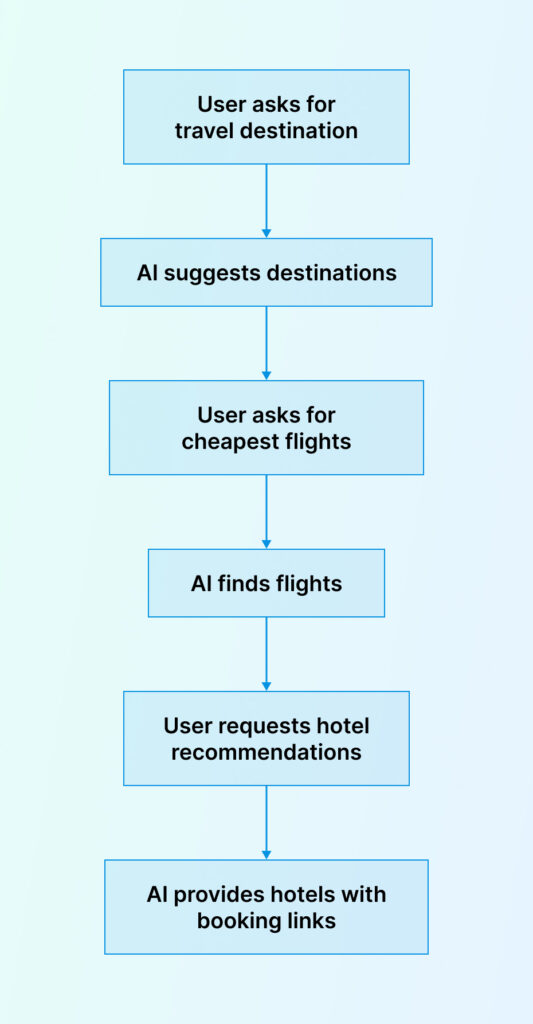
This creates a continuous search journey rather than isolated keyword queries.
AI Search Agents: Google’s Biggest Competitive Move
Google introduced AI-powered Search Agents, autonomous assistants that continuously monitor the web on behalf of users.
These agents operate in the background and can:
- Monitor product launches
- Track ticket availability
- Watch price drops
- Alert users about sneaker releases
- Track sports announcements
- Find limited-time offers
- Monitor appointment openings
This feature positions Google beyond a search engine and closer to a proactive AI assistant ecosystem.
Example Use Cases of Search Agents
Sneaker Release Tracking
Users can ask:
“Notify me when the next Travis Scott sneaker collaboration drops under $250.”
The agent continuously monitors:
- News websites
- Retail marketplaces
- Brand announcements
- Social media updates
Event Ticket Monitoring
Users can request:
“Alert me if Taylor Swift concert tickets become available in Mumbai.”
The AI agent tracks availability automatically.
AI-Powered Booking Capabilities
Google Search AI Mode now includes enhanced booking workflows.
Users can search naturally:
“Book a private karaoke room for six people on Friday night with food service after 11 PM.”
Google AI Mode then:
- Searches businesses
- Compares pricing
- Checks availability
- Presents options
- Provides direct booking links
This significantly reduces friction in local commerce discovery.
Google Can Now Call Businesses for Users
One of the most disruptive additions is Google’s AI calling feature.
For select industries like:
- Beauty salons
- Home repair services
- Pet care providers
Google can contact businesses directly on behalf of users.
How It Works
Step 1: User Provides Criteria
Example:
“Find a dog grooming appointment tomorrow under $50.”
Step 2: AI Calls Businesses
Google’s AI contacts providers to:
- Check availability
- Confirm pricing
- Verify services
Step 3: Summary Returned
The user receives:
- Appointment options
- Pricing details
- Business confirmations
This transforms Google Search into an active service intermediary.
Google Antigravity: AI App Creation Inside Search
Google has integrated Google Antigravity directly into AI Mode.
Antigravity is an AI-powered development system capable of generating:
- Interactive dashboards
- Simulations
- Tables
- Graphs
- Mini applications
- Visual tools
Users can create functional tools using simple prompts.
Real-World Example of Google Antigravity
A user searching for health planning could request:
“Create a fitness routine tracker for beginners.”
Google Antigravity may generate:
- Weekly workout schedules
- Meal tracking systems
- Interactive progress charts
- Route maps for walking or running
- Daily reminders
This effectively turns Search into a lightweight no-code application builder.
Why Google Antigravity Changes SEO Forever
Traditional SEO focused on ranking web pages.
Now, Google can:
- Generate tools directly
- Summarize content instantly
- Build interfaces inside search
- Deliver interactive experiences without external websites
This creates major implications for:
- Publishers
- SaaS companies
- Affiliate marketers
- Bloggers
- Local businesses
Websites must now provide:
- Original expertise
- Unique tools
- Deep authority
- First-party insights
- Interactive experiences
Generic informational content becomes significantly less competitive.
Gmail, Photos and Calendar Integration
Google’s Personal Intelligence integration allows AI Mode to connect with:
- Gmail
- Google Photos
- Google Calendar
This enables hyper-personalized search experiences.
Example Scenarios
Travel Planning
Google can analyze:
- Flight confirmations from Gmail
- Vacation photos
- Calendar availability
Then generate personalized travel suggestions.
Restaurant Recommendations
Google may consider:
- Past reservations
- Dining preferences
- Calendar schedules
- Favorite cuisines
This level of contextual personalization surpasses traditional search entirely.
Impact on SEO and Content Marketing
Google AI Mode introduces major shifts in SEO strategy.
Keyword SEO Is No Longer Enough
Ranking now depends on:
- Entity authority
- Contextual relevance
- Conversational optimization
- Semantic depth
- Experience-driven content
The Rise of Conversational SEO
Beyond traditional SEO, a new discipline is emerging: Generative Engine Optimization (GEO). The goal is no longer just to rank on page one, it’s to be cited inside AI-generated answers. If Google’s AI doesn’t reference your content, you’re effectively invisible to a growing segment of users.
Content must now answer:
- Follow-up questions
- Multi-layered user intent
- Natural language prompts
Old SEO Example
“Best running shoes 2026”
New AI Search Query
“What are the best running shoes for flat feet under $150 for marathon training?”
Content must address nuanced intent directly. The difference isn’t just phrasing, it’s intent depth. AI Mode identifies the outcome behind the query, not just the words. This means your content must directly address the specific problem, constraints and context a user is expressing.
Structure your content around real questions: use ‘How do I…?’, ‘What’s the difference between…?’, and ‘Why does…?’ as H2/H3 headings. Write in second person, keep sentences clear, and explain jargon with practical examples.
Tracking performance in AI Mode requires a new approach. Google Search Console cannot currently separate AI Mode impressions from traditional search clicks. Shift your measurement focus to brand mention tracking, citation monitoring and AI share of voice.
Content Formats Most Likely to Win in AI Search
1. Expert-Level Long-Form Guides
Deep, authoritative content performs better than shallow summaries.
2. Experience-Based Content
First-hand expertise becomes more valuable.
3. Interactive Tools
Calculators, quizzes, planners and visualizers gain importance.
4. Structured Data Optimization
Schema markup becomes critical for AI interpretation.
5. Multimedia Integration
AI increasingly favors:
- Videos
- Visual explainers
- Infographics
- Interactive diagrams
How Businesses Should Adapt to Google AI Mode
1. Build Topical Authority
Websites must dominate niche expertise rather than publish scattered articles.
2. Optimize for Conversations
Content should mirror natural human questions.
3. Improve Trust Signals
Google increasingly values:
- Author expertise
- Brand credibility
- Citations
- Original research
4. Develop Interactive Experiences
Tools and calculators provide defensible value against AI summaries.
Future of Search: From Search Engine to AI Assistant
Google is evolving from:
to
- AI operating layer for the internet
The company’s direction is clear:

This transition represents one of the most significant technological shifts since the birth of modern search engines.
Will Traditional Google Search Disappear?
No.
Google confirmed that traditional search results with blue links remain available.
However, AI-generated experiences are becoming increasingly prominent.
Over time, user behavior will likely shift toward:
- Conversational queries
- Personalized recommendations
- AI-assisted workflows
- Automated search tasks
Traditional keyword search may gradually become secondary for many users.
Key Features of Google Search AI Mode
- Conversational Search: Natural back-and-forth interactions with Google.
- Follow-Up Questions: Context-aware conversations without restarting queries.
- AI Search Agents: Autonomous assistants monitoring information continuously.
- Smart Booking System: AI-assisted reservations and appointments.
- Business Calling Feature: Google contacts businesses on behalf of users.
- Google Antigravity: Prompt-based app and visual generation.
- Personal Intelligence: Deep personalization using Gmail, Photos and Calendar.
What This Means for the Internet Ecosystem
The implications are enormous.
Winners
- Trusted brands
- Original creators
- Expert publishers
- Businesses with proprietary data
- Interactive platforms
Losers
- Thin affiliate sites
- Generic blogs
- Rewritten AI content
- Low-authority websites
- Commodity informational pages
Final Thoughts
Google Search AI Mode is not simply a new feature.
It represents:
- A new search paradigm
- A new SEO environment
- A new content economy
- A new user behavior model
The integration of conversational AI, autonomous agents, personalized intelligence and interactive application generation signals the beginning of an AI-native internet experience.
Businesses, publishers and marketers that adapt early to conversational intent, authority-driven content and interactive value creation will gain a substantial competitive advantage in the evolving search landscape.
And remember: Google isn’t the only AI search surface anymore. Visibility on ChatGPT, Perplexity and Bing Copilot is becoming equally important for brand discovery.
FAQs
1. What is Google Search AI Mode?
Google Search AI Mode is a conversational search experience powered by Gemini AI that allows users to ask natural-language questions, receive synthesized answers, perform tasks and engage in follow-up conversations directly within Google Search.
2. How is Google AI Mode different from traditional Google Search?
Traditional Google Search primarily returns a list of web pages based on keywords. Google AI Mode understands conversational intent, provides AI-generated responses, supports follow-up questions, automates tasks and delivers more personalized results based on context.
3. What are Google AI Search Agents?
Google AI Search Agents are autonomous assistants that can monitor the web on a user’s behalf. They can track product releases, ticket availability, price changes, appointment openings and other updates, then notify users when specific conditions are met.
4. How will Google AI Mode impact SEO?
Google AI Mode shifts SEO beyond keywords toward topical authority, semantic relevance, conversational content, structured data and first-hand expertise. Websites that offer unique insights, original research and interactive tools are more likely to remain competitive in AI-powered search results.
5. Can Google AI Mode make bookings and contact businesses?
Yes. Google AI Mode can help users find available appointments, compare options and in some cases contact businesses directly to verify pricing, availability and services before presenting recommendations to the user.
6. Will Google AI Mode replace traditional search results?
No. Google has stated that traditional search results and blue links will remain available. However, AI-generated answers, conversational interactions and task-based experiences are expected to become a more prominent part of how users search and discover information online.
Source:
Google Search AI Mode Biggest Update – USA Today
Author
Jayesh Patel
Jayesh Patel is a Professional Web Developer & Designer and the Founder of InCreativeWeb.
As a highly Creative Web/Graphic/UI Designer - Front End / PHP / WordPress / Shopify Developer, with 14+ years of experience, he also provide complete solution from SEO to Digital Marketing. The passion he has for his work, his dedication, and ability to make quick, decisive decisions set him apart from the rest.
His first priority is to create a website with Complete SEO + Speed Up + WordPress Security Code of standards.