Artificial Intelligence (AI) has rapidly evolved from a futuristic concept into a practical business tool that is reshaping industries worldwide. Among the sectors experiencing significant transformation is web development. From generating code snippets and designing interfaces to automating testing and deployment, AI-powered tools are becoming an integral part of modern development processes.
As businesses seek faster delivery times, reduced costs, and improved efficiency, a common question emerges: Can artificial intelligence replace traditional web development workflows entirely?
The answer is more complex than a simple yes or no. While AI has demonstrated remarkable capabilities in automating repetitive development tasks, traditional web development involves creativity, strategic thinking, user experience design, and business understanding – areas where human expertise remains essential.
In this article, we’ll explore how AI is transforming web development, its strengths and limitations, and whether it has the potential to replace traditional development workflows in the future.
Understanding Traditional Web Development Workflows
Before evaluating AI’s impact, it’s important to understand what traditional web development workflows typically involve.
A standard web development project often consists of several stages:
- Requirement gathering and business analysis
- User experience (UX) research
- User interface (UI) design
- Front-end development
- Back-end development
- Database architecture
- Testing and quality assurance
- Deployment and maintenance
Each phase requires collaboration between developers, designers, project managers, stakeholders, and clients to ensure the final product aligns with business objectives and user expectations.
Traditional workflows have proven effective for decades but often face challenges such as lengthy development cycles, repetitive tasks, communication gaps, and increasing project complexity.
The Rise of AI in Web Development
Artificial Intelligence has introduced a new layer of automation and intelligence into the development process.
Modern AI-powered tools can assist developers by:
- Generating code automatically
- Suggesting bug fixes
- Creating documentation
- Writing unit tests
- Optimizing code performance
- Assisting with UI design
- Automating deployment processes
Tools such as AI coding assistants, automated testing platforms, and intelligent design systems are helping teams work more efficiently than ever before.
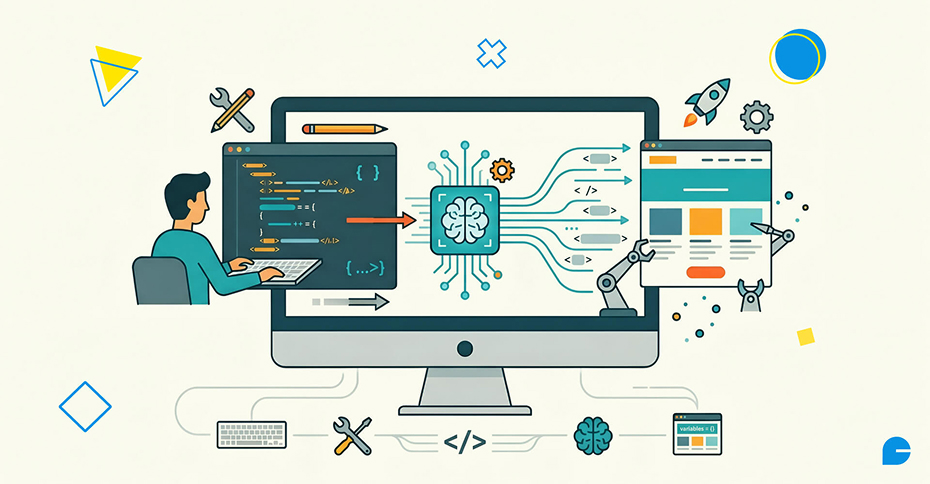
Rather than replacing developers outright, AI is becoming an advanced collaborator that handles repetitive and time-consuming tasks.
How AI Is Transforming Traditional Development Workflows
1. Automated Code Generation
One of the most visible applications of AI in web development is automated code generation. Developers can now describe a feature in plain language and receive working code suggestions within seconds.
AI can generate:
- HTML structures
- CSS styling
- JavaScript functions
- API integrations
- Database queries
- Reusable components
This significantly reduces development time and allows teams to focus on solving more complex business problems.
Benefits
- Faster development cycles
- Reduced manual coding
- Improved productivity
- Rapid prototyping capabilities
2. Intelligent Debugging and Error Detection
Debugging is often one of the most time-consuming aspects of development.
AI-powered systems can:
- Detect coding errors
- Identify vulnerabilities
- Suggest corrections
- Analyze performance bottlenecks
- Predict potential system failures
Instead of manually reviewing thousands of lines of code, developers can leverage AI to quickly pinpoint issues and implement fixes.
Benefits
- Faster issue resolution
- Higher code quality
- Reduced downtime
- Improved software reliability
3. Automated Testing
Quality assurance is essential for every web application. Traditionally, QA teams spend considerable time creating test cases, executing tests, and reporting bugs.
AI-powered testing tools can:
- Generate test scenarios automatically
- Perform regression testing
- Identify UI inconsistencies
- Monitor application behavior
- Predict high-risk areas
This enables organizations to maintain high quality standards while reducing testing costs and timelines.
4. AI-Assisted UI/UX Design
Modern AI tools are also entering the design phase of web development.
Designers can use AI to:
- Generate layouts
- Create wireframes
- Suggest color palettes
- Optimize user flows
- Produce design variations
While AI can accelerate design creation, human designers still play a critical role in ensuring emotional engagement, brand consistency, and user-centered experiences.
5. Content and Documentation Generation
Documentation is often overlooked but remains essential for long-term project success.
AI can automatically generate:
- Technical documentation
- API references
- User guides
- Release notes
- Project summaries
This reduces administrative workloads and ensures documentation remains up to date throughout the development lifecycle.
Areas Where AI Excels
AI performs exceptionally well in situations involving repetition, pattern recognition, and large-scale data analysis.
1. Repetitive Development Tasks
AI can efficiently handle:
- CRUD operations
- Form generation
- Template creation
- Basic integrations
- Standardized coding patterns
2. Rapid Prototyping
Businesses can quickly validate ideas by using AI-generated prototypes before investing significant resources into full-scale development.
3. Productivity Enhancement
Development teams can complete projects faster by automating routine work and focusing on strategic initiatives.
4. Large-Scale Data Analysis
AI can analyze user behavior, application performance, and system metrics to provide actionable insights that improve decision-making.
Check this out: Emerging Web Development Trends in 2026 You Should Know
Where Artificial Intelligence Still Falls Short
Despite its impressive capabilities, AI has limitations that prevent it from fully replacing traditional web development workflows.
1. Strategic Architecture Decisions
Building scalable, secure, and maintainable systems requires long-term planning and business understanding.
AI can provide recommendations, but final architectural decisions often depend on factors such as:
- Business goals
- Budget constraints
- Growth projections
- Regulatory requirements
- Industry-specific needs
These decisions require human judgment and experience.
2. Understanding Business Context
Every business has unique objectives, customers, and operational challenges.
AI may generate technically correct solutions but often struggles to understand:
- Company vision
- Customer expectations
- Market positioning
- Competitive advantages
Successful web solutions require aligning technology with business strategy, something that still relies heavily on human expertise.
3. Creative Problem Solving
Innovation rarely follows predictable patterns.
Developers frequently encounter unique challenges that require:
- Critical thinking
- Creative experimentation
- Strategic trade-offs
- Human intuition
AI excels at recognizing patterns but is less effective when confronted with entirely novel situations.
4. User Experience and Emotional Design
Great websites do more than function correctly-they create memorable experiences.
Human designers understand:
- Emotional triggers
- Brand storytelling
- User psychology
- Accessibility needs
- Cultural differences
These aspects remain difficult for AI to replicate authentically.
AI vs Traditional Web Development
| Factor |
Traditional Development |
AI-Assisted Development |
| Coding Speed |
Moderate |
High |
| Creativity |
Excellent |
Limited |
| Business Understanding |
Strong |
Weak |
| Automation |
Limited |
Extensive |
| Strategic Planning |
Strong |
Limited |
| User Experience Design |
Strong |
Moderate |
| Problem Solving |
Advanced |
Pattern-Based |
| Maintenance Efficiency |
Moderate |
High |
The comparison highlights an important reality: AI enhances development workflows but does not fully replace human expertise.
The Emergence of AI-Augmented Development Teams
The future of web development is unlikely to be AI versus developers.
Instead, we are witnessing the rise of AI-augmented teams where:
- Developers use AI coding assistants
- Designers leverage AI-generated concepts
- QA teams automate testing workflows
- Project managers utilize predictive analytics
- Businesses accelerate digital transformation
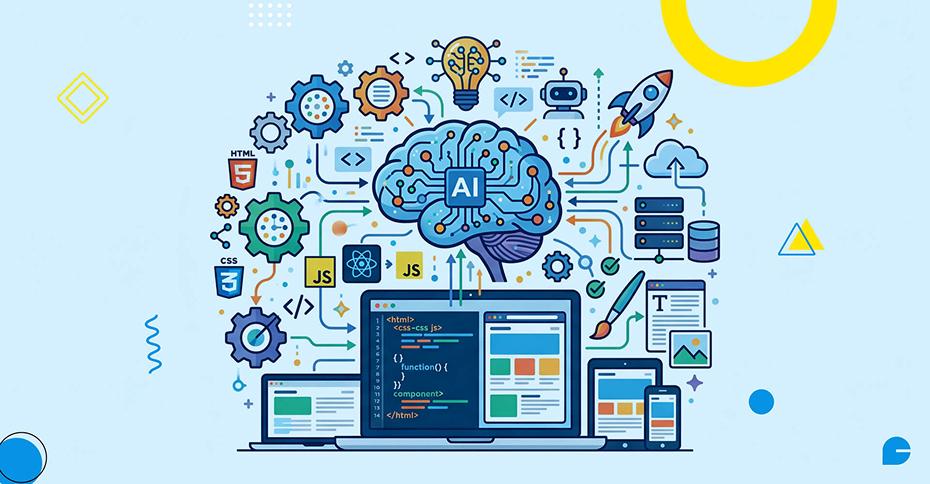
In AI-Augmented Development team model, AI becomes a productivity multiplier rather than a replacement for human professionals.
Benefits of Combining AI with Traditional Development
Organizations that successfully integrate AI into their workflows can gain significant advantages.
- Faster Project Delivery: Automation reduces development timelines and accelerates product launches.
- Lower Operational Costs: By minimizing repetitive manual tasks, businesses can optimize resource allocation.
- Improved Quality: AI-assisted testing and code reviews help identify issues earlier in the development process.
- Better Scalability: Development teams can manage larger projects more efficiently with AI support.
- Enhanced Innovation: With routine work automated, developers can focus on innovation and strategic initiatives.
Potential Risks of Over-Reliance on AI
While AI offers substantial benefits, excessive dependence can create challenges.
- Security Vulnerabilities: AI-generated code may introduce security risks if not reviewed properly.
- Inaccurate Outputs: AI can occasionally produce incorrect or misleading solutions that require human validation.
- Technical Debt: Automatically generated code may not always follow best practices or long-term maintainability standards.
- Reduced Human Oversight: Organizations that rely too heavily on automation may overlook critical business and user considerations. Maintaining human involvement remains essential for quality assurance and strategic decision-making.
Will AI Replace Web Developers Completely?
The short answer is no. Artificial intelligence is transforming how websites and applications are built, but web development encompasses far more than writing code.
Successful projects require:
- Business strategy
- Human creativity
- User-centered design
- Communication
- Leadership
- Problem-solving
- Innovation
AI can automate tasks, accelerate workflows, and improve efficiency, but it cannot fully replicate the human skills that drive successful digital products.
Rather than replacing developers, AI is changing the nature of their work and enabling them to become more productive and impactful.
The Future of Web Development
As AI technologies continue to advance, we can expect several emerging trends:
- AI-Driven Development Plan
- Successful organizations will combine human expertise with AI efficiency to create innovative digital experiences.
Conclusion
Artificial Intelligence is undoubtedly revolutionizing web development workflows. From code generation and automated testing to intelligent design assistance and documentation, AI is helping teams work faster and more efficiently than ever before. However, traditional web development involves strategic thinking, creativity, business understanding, and human-centered design-areas where AI still has significant limitations.
The future is not about AI replacing web developers. It is about developers and businesses leveraging AI as a powerful tool to enhance productivity, improve quality, and accelerate innovation. Organizations that embrace this collaborative approach will be best positioned to thrive in the next generation of digital development.
Ready to Build Smarter with AI-Powered Web Development Services?
At InCreativeWeb, we offer professional Web Development Services that blend human creativity with cutting-edge AI tools to deliver faster, smarter, and more impactful web solutions. Whether you’re looking to modernize your existing workflows or build a powerful digital presence from the ground up, our expert team is here to help. Get in touch with us today and take the first step toward transforming your web development experience with a team that truly understands your business goals.
FAQs
1. What is the best WordPress hosting provider in 2026?
The best WordPress hosting provider in 2026 depends on your specific needs and budget. WordPress.com leads in overall speed and uptime, while Hostinger offers exceptional value for beginners and small businesses. For managed hosting, WP Engine provides enterprise-grade reliability, and Kinsta excels at handling WooCommerce stores and dynamic websites.
2. Is managed WordPress hosting worth the extra cost?
Yes, managed WordPress hosting is often worth the additional investment for businesses that prioritize performance, security, and reliability. In addition, managed hosting providers handle updates, backups, security monitoring, and server optimization, allowing website owners to focus on growth rather than technical maintenance.
3. Which WordPress hosting is best for WooCommerce stores?
Kinsta is widely regarded as one of the best hosting solutions for WooCommerce stores due to its high-performance infrastructure and ability to handle dynamic, logged-in user traffic. However, WP Engine and Cloudways are also strong alternatives for growing eCommerce businesses.
4. Does web hosting affect SEO rankings?
Yes, web hosting can directly impact SEO performance. Website speed, uptime, security, and server response times are important ranking factors that influence both search engine visibility and user experience. Therefore, choosing a reliable hosting provider can contribute to improved search rankings over time.
5. What should I look for when choosing a WordPress hosting provider?
When selecting a WordPress hosting provider, consider factors such as performance, uptime guarantees, security features, customer support, scalability, and pricing transparency. Additionally, server location, caching technology, and backup options can significantly affect your website’s long-term success.
6. Can I switch WordPress hosting providers without losing my website?
Yes, most WordPress websites can be migrated to a new hosting provider without downtime or data loss when the process is handled correctly. Furthermore, many hosting companies offer free migration services, making it easier to transfer your website, databases, and files to a new server.
7. Which type of WordPress hosting is best for beginners?
For beginners, shared WordPress hosting is often the most affordable and user-friendly option. Providers such as Hostinger and GreenGeeks offer simple setup processes, intuitive dashboards, and essential features that make launching a website easier for first-time users.
Author
Jayesh Patel
Jayesh Patel is a Professional Web Developer & Designer and the Founder of InCreativeWeb.
As a highly Creative Web/Graphic/UI Designer - Front End / PHP / WordPress / Shopify Developer, with 14+ years of experience, he also provide complete solution from SEO to Digital Marketing. The passion he has for his work, his dedication, and ability to make quick, decisive decisions set him apart from the rest.
His first priority is to create a website with Complete SEO + Speed Up + WordPress Security Code of standards.